
Services
Rebar Tying: What the Ties Are Actually For
Ties are not structural — they hold position. Which is exactly why doing them badly ruins a mat that was placed correctly, in a way nobody can see afterwards.
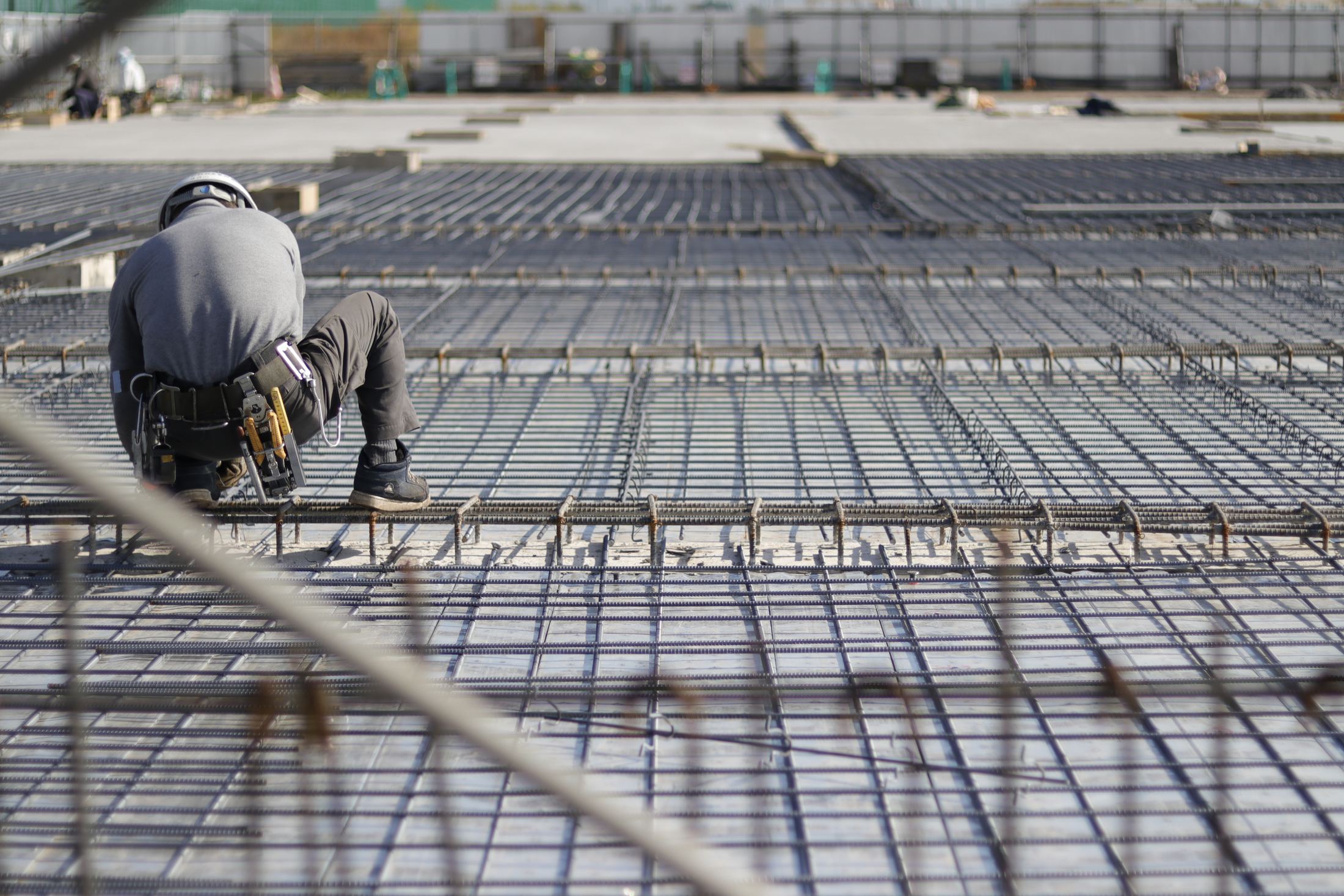
Tie wire carries no design load. Its whole job is to hold the reinforcement in the position the drawing specified until the concrete has gone around it and taken over. That sounds minor and it is not, because everything upstream depends on the steel staying put.
Consider what that means. An engineer calculates a required steel area and sets a spacing. A detailer turns it into a placement drawing. A crew places it correctly. An inspector verifies it. Every one of those steps describes the geometry at a moment in time — and the only thing carrying that geometry forward to the moment concrete arrives is wire and chairs. Tying is where the whole chain either holds or quietly stops being true.
What ties resist
Between tying and the pour, a mat gets walked on, hit with hoses, loaded with buggies, and finally hit with concrete moving at pressure. Every one of those wants to shift bar. Ties, together with chairs and bolsters, are what stops it.
The forces are more significant than they look. Concrete arriving from a pump hits placed steel with real momentum; a vibrator inserted beside a bar transmits energy directly into the cage; a laser screed running over a slab is a heavy machine on a surface whose only support is chairs. None of these are gentle, and all of them are applied for hours.
There is also buoyancy, which surprises people. Fresh concrete is dense enough that a light cage in a deep pour wants to float, and a top mat held down only by its own weight can rise. On deep mats and walls, ties are resisting uplift as well as displacement.
Tie patterns
Not every intersection needs a tie. The drawings or the spec give a pattern — a proportion of intersections, with edges and corners always tied. Tying every intersection on a large mat is slower without being better; tying too few leaves a mat that racks under traffic.
- Snap tie — the standard for flat intersections.
- Wrap and saddle ties — where the joint has to resist more than a snap tie will hold.
- Figure-eight — where a joint needs to resist racking in the plane of the mat.
The pattern is a structural-adjacent decision even though the wire is not structural. A mat tied at every second intersection behaves differently under traffic from one tied at every fourth, and the difference shows up as displacement rather than as anything visible on the finished element.
Edges and corners are always tied for a specific reason: they are where a mat is least restrained and most likely to lift or spread, and they are where cover is most exposed to being lost against a form face.
Column cages are a different problem again. There, the tie is both a structural element — confinement steel, which does carry load — and the thing holding the cage square while it is lifted, set and plumbed. A column cage that racks during handling arrives at the forms out of shape, and out-of-shape cages produce eccentric reinforcement and lost cover on one face.
Tools and speed
Battery-powered tying tools have changed the economics of large mats and they are also an ergonomics decision. Manual tying is hard on wrists and backs over a full deck, and a crew whose hands are done by two in the afternoon is not going to hold your tolerance.
That last point is worth taking seriously rather than treating as a nicety. Tie quality is not uniform across a shift when it is done by hand — it degrades, predictably, in the way any fine motor task degrades with fatigue. On a large industrial slab placed in a single day, the difference between the first bay and the last is a real quality gradient, and it lands in the part of the mat poured last, under the most time pressure.
Powered tools flatten that curve. They also change the labour arithmetic on big pours, which matters in a region where crew availability is the binding constraint more often than crew skill.
Hand tying remains the right tool for detail work — congested joints, awkward geometry, anywhere a tool cannot reach — so the question is not which method but whether a crew has both.
Wire, and the small decisions inside it
Tie wire is usually annealed black wire, soft enough to twist and strong enough to hold. Where the reinforcement is coated, the tie wire has to be coated too — a black wire tie on an epoxy mat is a metal-to-metal contact at a break in the coating, which is exactly the discontinuity the coating was specified to prevent.
Twist ends matter more than they seem. Tie ends left standing proud toward a form face are a cover problem: the wire itself sits closer to the surface than the bar does, and on an exposed soffit it rusts and stains, then tracks. Ends turned inward is a one-second habit that prevents a visible defect on the finished concrete.
Where quality shows up
A well-tied mat looks unremarkable and stays exactly where it was when the concrete arrived. A poorly tied one looks fine at the walk-through and is a different geometry by the time the pour is finished. Since nobody sees it after that, this is a place where the standard has to be internal.
That sentence is the honest core of this article. There is no inspection after the pour that finds a mat that settled during it. The cover meter reads what is there; nobody knows what was approved. The only defence is a crew that ties properly when nobody is checking, and a sequence that does not put them under pressure to skip it.
It is also why tying belongs in a conversation about price. Ties and supports are labour and materials that produce no visible product, which makes them the first things trimmed by a bid under pressure — and the last things anyone can verify.
If you want to know how a reinforcement contractor ties before you find out the expensive way, that is a conversation worth having.