

Services
Rebar Placement: The Sequence That Keeps a Pour on Schedule
Placement is a sequencing discipline before it is a physical one. What a good sequence looks like, what it protects, and why the inspection window is the part that gets deleted first.
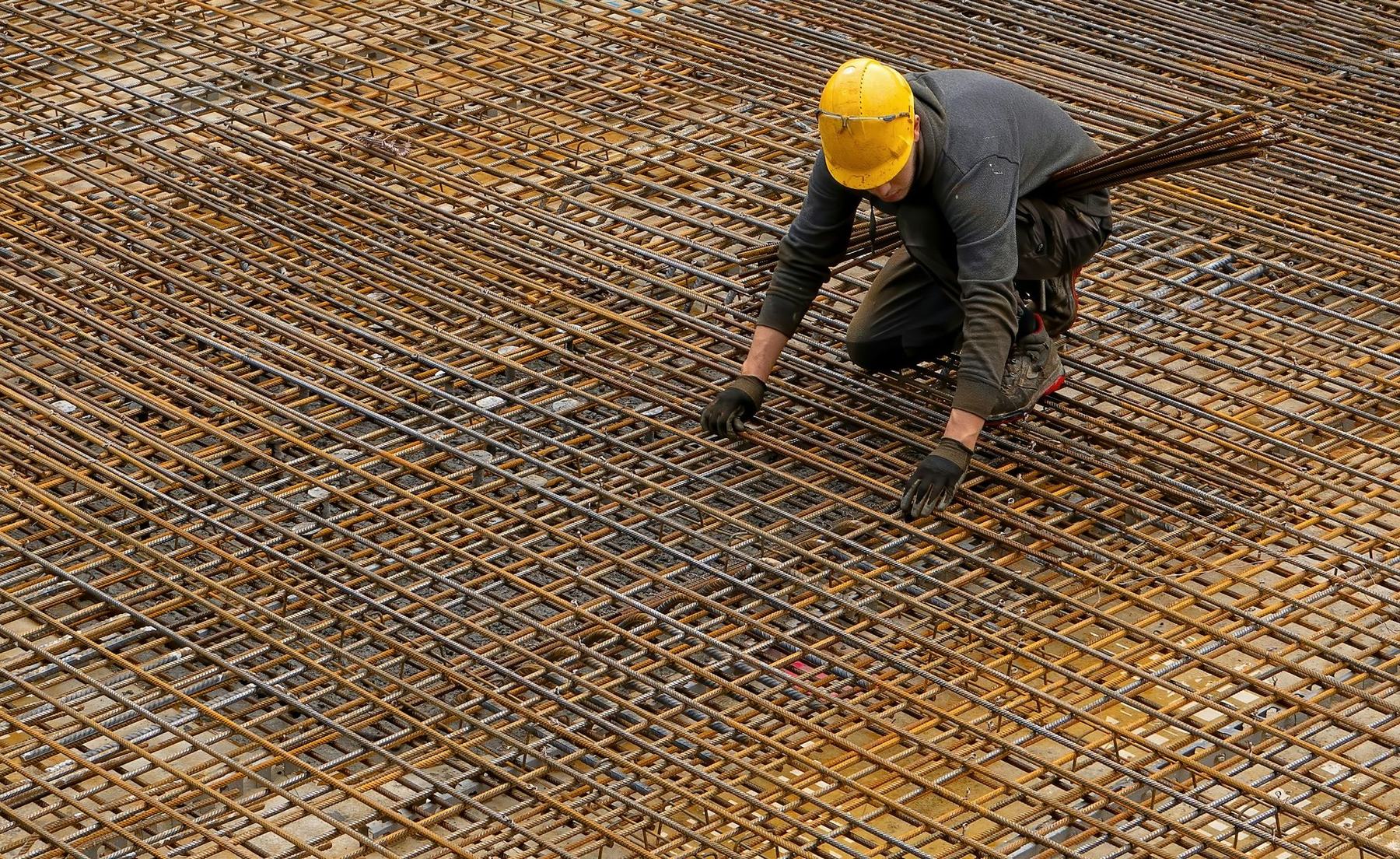
Reinforcement sits on the critical path. The pour waits on the steel, the next floor waits on the pour, and the finishing trades wait on that. Which means placement is judged on a date as much as on a tolerance.
It is worth being precise about what that does to the work. On most trades, a bad day costs a day. On reinforcement, a bad day costs the pour — and a missed pour costs the concrete supplier's slot, the pump, the finishing crew, and the position of every trade queued behind the element. That asymmetry is why sequencing matters more here than craft, and why a crew that is fast and out of order is worse than a crew that is steady and in order.
The sequence is the plan
A crew opening a placement drawing needs to know three things: what goes here, in what order, and what it has to clear. The second one is where schedules are won.
- Bottom mat, then verticals, then top mat, in an order somebody can physically walk without standing on finished work.
- Embeds and sleeves set with the steel, not after it, so nothing has to come out.
- Access maintained to the last area to be tied, so the final inspection is not conducted across a completed mat.
That first bullet is a default rather than a rule, and the exceptions are where the money is. In a congested element the order is dictated by geometry: at a column-to-beam joint, beam bottom steel may have to pass through the column cage before the column ties can close, which means a tie installed early has to come out. Nobody discovers that on a drawing. They discover it at seven in the morning, or a detailer discovers it during the submittal and writes the order down.
The third bullet is the one most often overlooked and the cheapest to fix. If the last area to be tied is in the middle of the mat, the inspector walks across finished work to reach it, the crew follows to make corrections, and the cover they are walking over is being spent to inspect the cover they came to check. Working toward an exit is a free decision made once.
Sequencing to the pour, not to the element
A drawing shows a finished element. A pour takes a piece of it. The gap between those is where reinforcement schedules break.
A mat or a deck is placed in bays with construction joints between them, and each bay has to be complete, inspected and released before concrete arrives. That means the bar list has to be organised by pour rather than by element — bundles tagged and delivered in the order the crew will place them, landed where they can be reached without crossing tied steel.
The symptom of getting this wrong is unmistakable and is always misdiagnosed as a placement problem: a crew moving steel twice, a laydown yard that has to be excavated to find the next bundle, and an inspection that cannot be called because the last twenty bars are under a pallet of the next bay's steel. That is a supply and delivery failure wearing a placement failure's clothes.
What crosses a construction joint
Every bay boundary is a decision about continuity. Bar that has to lap into the next placement must project from the current one, at the right length, in the right position, and it has to survive being walked past for however long the next bay takes.
That means the joint detail, the lap length and the formwork have to agree before the first pour rather than after it. Dowels bent aside to clear a form and bent back later are a known way to damage bar, and dowels set to the wrong projection are discovered when the next bay's steel will not lap.
On vertical work the same logic governs column dowels out of a mat: position and projection are set by an element that does not exist yet, which is exactly the kind of thing that gets approximated under time pressure and surveyed afterwards.
Coordination before the deck
Mechanical, electrical and plumbing all pass through structural elements. Every one of those conflicts is resolvable on paper and expensive on the deck. Overlaying the reinforcement package against the MEP drawings is a day of somebody's time and it routinely saves a morning of everyone's.
The sequencing dimension of that is often missed. It is not only whether a sleeve conflicts with a bar — it is when the sleeve arrives. Embeds set after the top mat is tied mean steel comes out and goes back; embeds set before the bottom mat means the crew works around them all day. Neither is automatically right, but one of them is right for a given element, and deciding it in advance is free.
On congested building types this is the difference between a schedule and a hope. A data centre equipment floor will generate conflicts; the only question is whether they are found in an overlay or at the pour.
The inspection window
Placement is not finished when the last tie is made. It is finished when the inspector has walked it and the cover has been verified. A sequence that leaves no time between the last tie and the pour has quietly eliminated the only opportunity to find anything.
This is the single most common way a reinforcement programme is compressed, because it is the compression nobody has to announce. The pour stays where it is, the placement start slips, and the window closes from the back. Everyone can see the pour date; almost nobody is tracking the gap.
The cost of that decision only appears when something is wrong — which is precisely the case the window exists for. A mat that fails inspection at eight with concrete booked for nine does not cost the correction. It costs the pump, the trucks, the standing crew, the finishers and the slot.
Holding the window is therefore not caution, it is the cheapest insurance on the element. It is also the thing to ask a reinforcement contractor about directly, because the answer reveals how they behave under pressure.
After the last tie, before the concrete
The hours between inspection and pour are not neutral. A mat that was correct when signed off gets walked, dragged over and vibrated, and if the ties and supports are not doing their job the geometry that was approved is not the geometry that gets encased.
So the final check is immediately before concrete, not at the end of the previous shift — a walk for displaced bar, for chairs that have punched into the subgrade, for cover at mid-span between supports, and for anything the MEP trades moved overnight.
During the pour, access matters. On a congested mat there is nowhere to stand that is not reinforcement, so walkways, screed rail support and the pump route have to be agreed before placement begins. A decision made at two in the morning by a pump operator is a decision made without the tie plan in front of him.
What we hold to
The pour plan gets the time the pour plan needs, or the date moves. It is a less comfortable conversation than the alternative, and it is the reason our dates mean something.
What a reinforcement contractor actually does on a job is mostly decided before the crew arrives — the detailing was right, the conflicts were resolved, the bundles are in the right place. If you want a pour sequence looked at before it is priced rather than after it is late, that is a conversation worth having.