

Rebar Basics
Post-Tension vs. Rebar: What Is Actually Different
They are not competing products. One reinforces passively, the other pre-loads the concrete — and most real structures use both, often in the same slab.
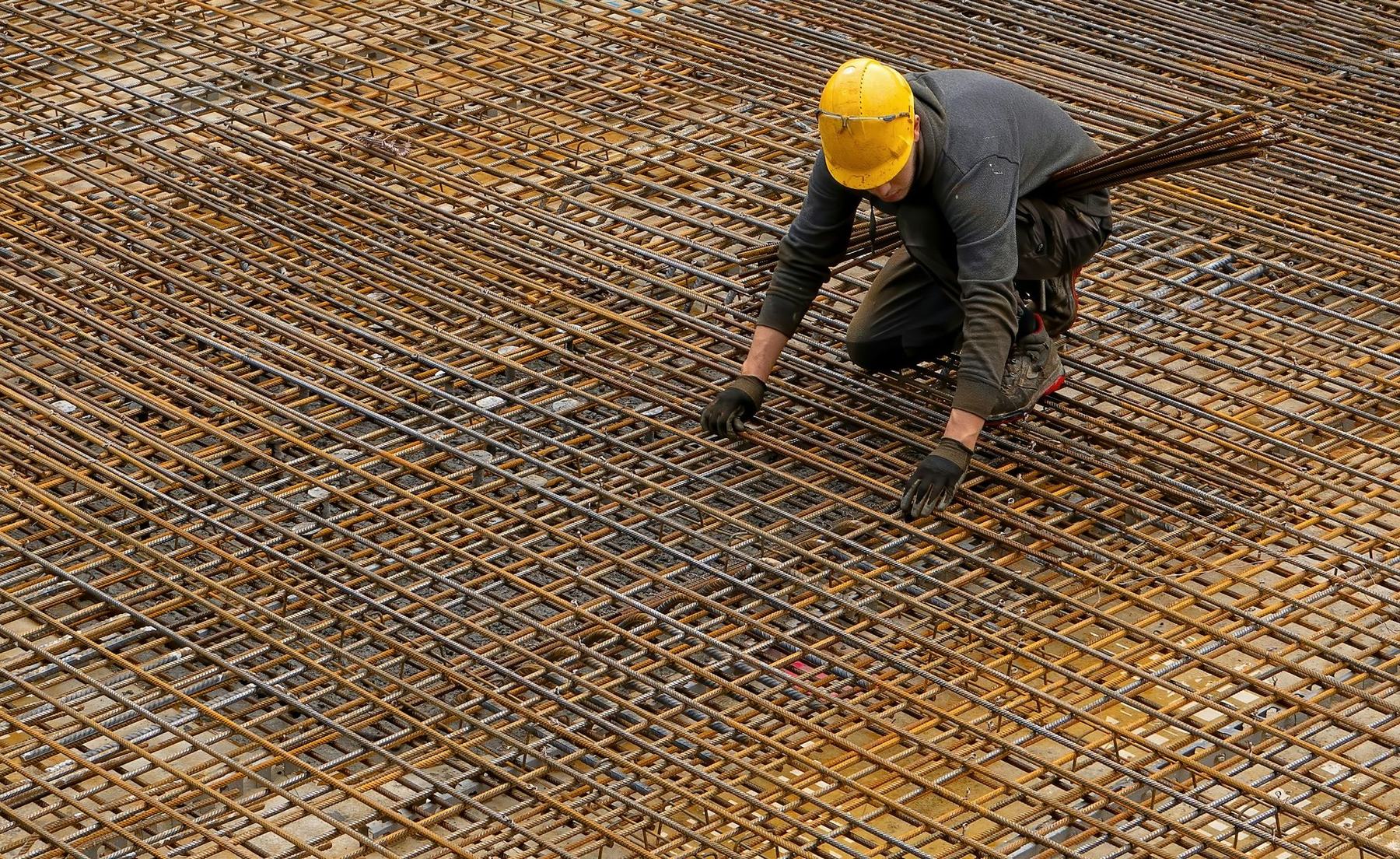
The framing "post-tension or rebar" suggests a choice between two ways of doing the same thing. In practice they do different jobs, and a great many buildings contain both — often in the same slab.
Conventional rebar is passive
Mild reinforcing bar sits in the concrete doing nothing until the element is loaded. Load arrives, the concrete on the tension face wants to stretch, and the steel takes it. The bar only works once the concrete has begun to crack, which is why crack widths, not collapse, govern a lot of the design.
That is worth sitting with, because it is counter-intuitive to anyone outside the trade. A conventionally reinforced beam in normal service is cracked. The cracks are fine, expected and designed for — what design controls is their width, because wide cracks admit water and chlorides and compromise cover. Passive reinforcement is a system that works by allowing controlled cracking.
Post-tensioning is active
Post-tensioning runs high-strength strand through ducts or sheathing, and after the concrete gains strength the strand is stressed and anchored. That squeezes the concrete permanently. A slab that is already in compression has to have that compression overcome before it can go into tension at all.
- Longer spans for the same depth.
- Thinner slabs, which compounds through the whole structure.
- Much tighter deflection and crack control.
- More complex sequencing, and anchorages that are unforgiving of error.
The compounding point is the one that drives the commercial case. A thinner slab is not just less concrete: it is less depth per floor, which across twenty floors is a storey of building height, or a storey more building inside a height limit. That arithmetic is why post-tensioning appears where it does.
The strand also does not run straight. It is draped — high over supports, low at mid-span — so that its geometry opposes the way the slab wants to bend. That drape is the design. A tendon pulled off its profile is not a tolerance issue; it is a member behaving differently from the one that was calculated.
Where they meet
A post-tensioned slab still needs conventional bar — at anchorage zones, around openings, as bonded reinforcement for crack distribution, and in columns and foundations that are almost always conventionally reinforced.
For the reinforcement crew that overlap is the whole story. On a PT job, placement is a coordination exercise: mild steel has to go where it is specified without displacing tendon profiles, because a tendon out of profile is a structural problem and not a tolerance one.
The anchorage zone is where that coordination is densest. Behind each anchor, the entire force of the tendon is delivered into a small area of concrete, which wants to split. The bursting and spalling reinforcement that prevents it is heavy, tightly spaced and located precisely — and it sits exactly where the tendon, its anchor and the slab edge are all competing for the same few inches.
Openings are the second congested case. A slab opening interrupts both the tendons and the mild steel, and the trimming bars around it have to develop their strength in a region that is already full. That is a development length problem in a confined space, and it is one of the places a detail that looks fine on paper turns out to be unbuildable.
Sequencing, and who goes first
On a PT deck the placement sequence is not a preference. Bottom mild steel, tendons at their chair heights, top mild steel and the anchorage reinforcement go in an order, and each trade's work physically obstructs the next if it is done out of turn.
The practical consequence is that a PT deck cannot be built by two crews working independently. It needs an agreed sequence, agreed chair heights and someone checking tendon profile after the mild steel is in — because the profile is checkable before the pour and permanent after it.
Stressing adds a second sequence after the pour. The slab is stressed once the concrete reaches a specified strength, and until then it is not carrying what it was designed to carry. That governs when forms and shores can come out, which governs the floor cycle, which is why PT schedules are tighter than they look.
Which one your project uses
That is the structural engineer's call, driven by spans, depth limits, and what the building is for. Parking structures and long-span floor plates are common PT candidates. Heavily loaded industrial slabs and most foundations stay conventional. Either way, somebody has to place the mild steel correctly.
Parking structures are the clearest case for it: long clear spans mean fewer columns to drive around, and shallow floors mean more levels within a height limit. Both are worth real money to an owner.
The clearest cases against it are buildings that will be drilled for the rest of their lives. A data centre is cored and penetrated continuously as tenant equipment changes, and a tendon cannot be cut. Heavy industrial floors sit in the same category, with the added consideration that their loads are concentrated and located rather than distributed.
There is a middle case worth knowing: post-tensioned slabs on grade, used to achieve very large jointless floor areas where joints are the failure mode. It solves a real problem and inherits the same penetration objection.
What a GC should ask on a PT job
If you are buying reinforcement on a post-tensioned structure, the questions that predict trouble are about the interface rather than about either trade alone.
Who owns the sequence, and is it written down? Have the anchorage zones and openings been checked for congestion before fabrication? Who verifies tendon profile after the mild steel is placed, and before the pour? And how are conflicts resolved — with the engineer, or on the deck?
Those are the same questions that matter on any congested structure, which is the underlying point: what a reinforcement contractor does on a PT job is not a different discipline, it is the ordinary one with less room for error.
Rucker places mild reinforcement on post-tensioned structures alongside conventional work across Missouri, Kansas, Iowa, Nebraska and Oklahoma. If you have a PT package and want the anchorage zones looked at before they are fabricated, that is a conversation worth having.