

Rebar Basics
Lap Splices and Development Length, Explained
Bar comes in finite lengths, so it has to be joined. What sets the overlap, why the number on the drawing is not negotiable, and why a short lap is the most common finding on an inspection.
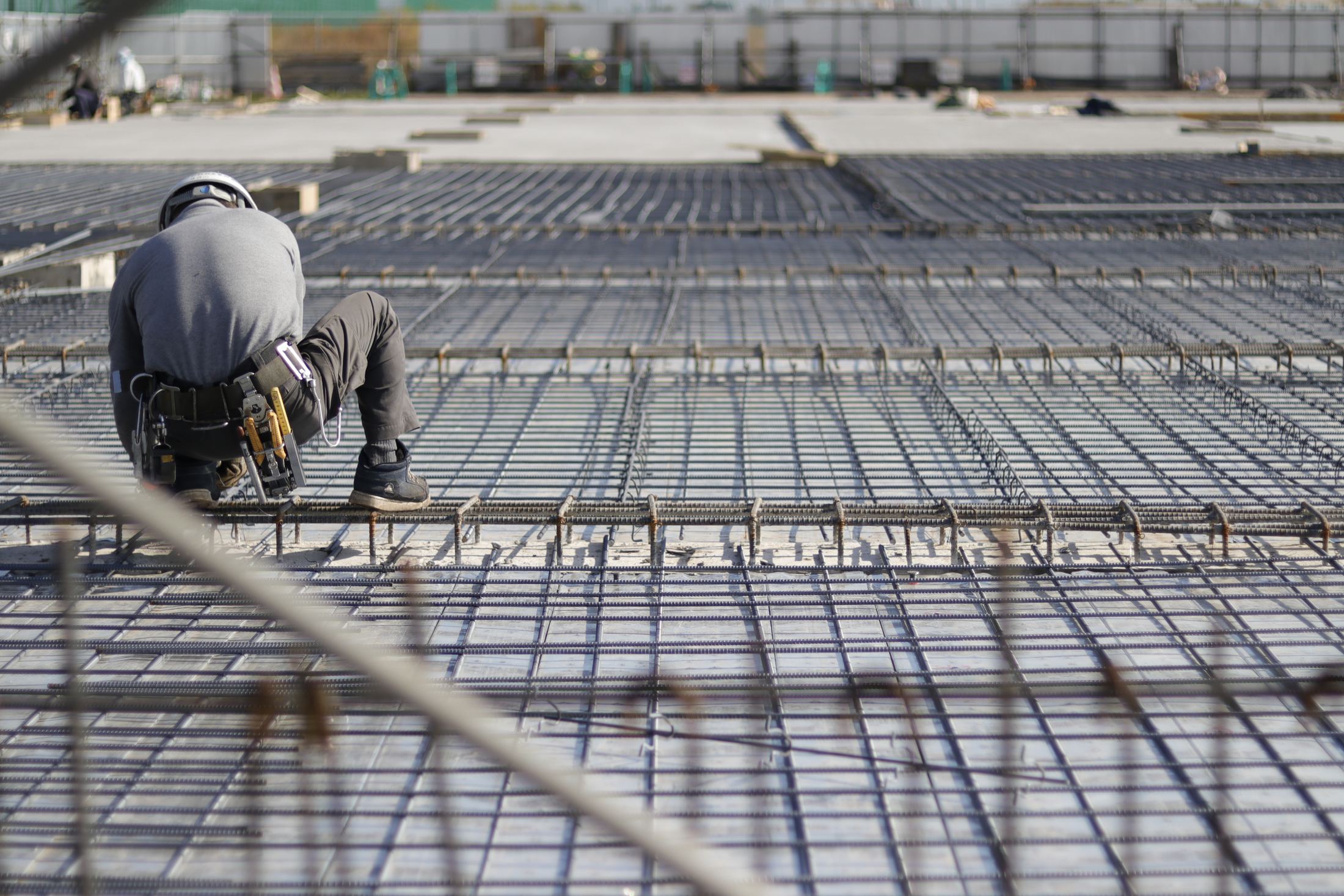
Reinforcing bar arrives in finite lengths and structures are longer than that, so bars get spliced. The most common way is the simplest: overlap two bars and let the concrete transfer the force between them.
That sentence contains the thing people miss. Lapped bars do not touch end to end and they are not joined to each other. The force leaves one bar into the concrete, travels through the concrete, and enters the other. The concrete is the splice. Everything about lap rules follows from that, including why cover, spacing and concrete strength all appear in a calculation that looks like it should only involve steel.
Development length first
Before splices make sense, development length does. It is the length of bar that has to be embedded in concrete for the bar to reach its full strength through bond alone — pull on a bar embedded less than that and it will slip before it yields.
Development length depends on bar size, grade, concrete strength, cover, spacing, coating and whether the bar is at the top of a deep pour. That is a lot of variables, which is why the number belongs on the drawings rather than in somebody's memory.
Each of those variables is doing something physical, and knowing which makes the number less arbitrary.
[Bar size](/newsroom/rebar-size-chart) — a larger bar carries more force and has proportionally less surface per unit of area, so it needs more length.
[Grade](/newsroom/rebar-grades-explained) — a higher-strength bar develops more force before yielding, so more has to be transferred.
Concrete strength — the bond depends on the concrete resisting splitting around the ribs. Stronger concrete, shorter development.
[Cover](/newsroom/concrete-cover-explained) and [spacing](/newsroom/rebar-spacing) — a bar near a face or crowded against its neighbours has less concrete to resist splitting, so it needs more length. This is why the same bar in the same building can have two different development lengths in two different elements.
Coating — epoxy reduces the friction between rib and concrete, so coated bar needs a longer development length than black bar.
Top-bar effect — bar with a lot of fresh concrete below it sits above material that bleeds and settles, leaving a weaker zone under the bar. Horizontal bar near the top of a deep placement therefore needs extra length.
Lap splices
A lap splice is two bars overlapping by enough length that force passes from one to the other through the concrete. The required lap is a function of development length and of what fraction of the bars are spliced at the same location — splicing everything at one section is penalised for good reason.
- Staggering matters. Laps offset along the run avoid concentrating a weak point at one section.
- Location matters. Laps belong in low-stress regions where the drawings put them, not wherever the last bar ran out.
- Contact vs. non-contact. Both are used; the drawings say which, and spacing rules apply either way.
The location point is worth expanding, because it is the one most often treated as a preference.
A bar is not uniformly stressed along its length. In a beam, the bottom steel is working hardest at mid-span and least near the supports; the top steel is the reverse. A lap placed where the bar is barely stressed has an easy job. The same lap at the point of maximum moment is being asked to transfer the bar's full force through concrete that is already cracked and working hard. That is why drawings specify splice locations, and why "we'll lap it where the bar ends" is a structural decision made by whoever was holding the bar.
What a lap actually costs in steel
Laps are not free tonnage, and they are one of the standard omissions in an inexperienced takeoff.
A lap adds its full length of bar to the job, at every splice, in every run. On a long wall or a large mat with many splices, that is real weight — enough that a takeoff without laps understates the package materially, and enough that a change in lap length during design review changes the tonnage.
It also adds congestion exactly where two bars occupy the same space. In a heavily reinforced column, the splice zone is the tightest region of the whole element, because every vertical bar is momentarily doubled. That is the practical driver behind couplers.
Mechanical and welded splices
Where congestion or bar size makes laps impractical — heavy columns, big mats — mechanical couplers join bars end to end. They cost more per splice and buy back space and, sometimes, schedule. Welded splices exist and carry their own qualification requirements.
A coupler occupies the footprint of one bar rather than two, which in a high-rise column can be the difference between a placeable detail and an unbuildable one. Couplers also remove the top-bar and cover penalties from the equation, since the splice no longer depends on bond at all.
What they add is cost per splice, installation discipline — a coupler is only as good as its engagement, and that is inspectable — and, for some types, a requirement that bar ends be cut square or threaded, which pushes work back into fabrication.
Welded splices are the least common of the three in commercial building work. Reinforcing bar is only weldable if it was specified as weldable, with a controlled carbon equivalent; welding ordinary bar embrittles it. Where welded splices are used they carry procedure qualification and inspection requirements of their own.
The field version
Short laps are one of the most common findings on a reinforcement inspection, and they are almost always the result of a run coming up short rather than a misunderstanding. It is worth saying plainly: an undersized lap is a structural defect, and no amount of schedule pressure changes that.
The mechanism is mundane. A wall run is laid out, the last bar in the run does not reach, and rather than send for another bar the crew closes the gap by shortening the lap at the end. It is a five-second decision that produces a splice that cannot develop the bar.
The defence is equally mundane: laps stated per element on the drawing the crew is holding, bar delivered to a list that accounts for laps, and a culture where sending for another bar is the normal answer. Where a run genuinely cannot work, the question goes to the engineer — and it is faster to ask than to place a run and take it back out.
What the submittal should say
"Laps per general note" is technically a specification and practically a delegation. It pushes a multi-variable calculation onto somebody with a tape measure at six in the morning.
A good submittal states lap and development lengths per element, or at minimum tabulates them by bar size and condition on the sheet where they will be used, and shows the splice locations rather than leaving them to be inferred. Where the job has more than one concrete strength, more than one grade, or coated bar in some elements and not others, that tabulation is not a courtesy — it is the only way the right number reaches the right bar.
If you want the lap schedule and splice locations checked on a set before it is fabricated, that is a conversation worth having.