

Rebar Basics
Rebar Grades: Why Grade 60 Is the Default
Grade is yield strength in ksi. What the common grades are, why Grade 60 dominates American commercial work, and when a job specifies something else.
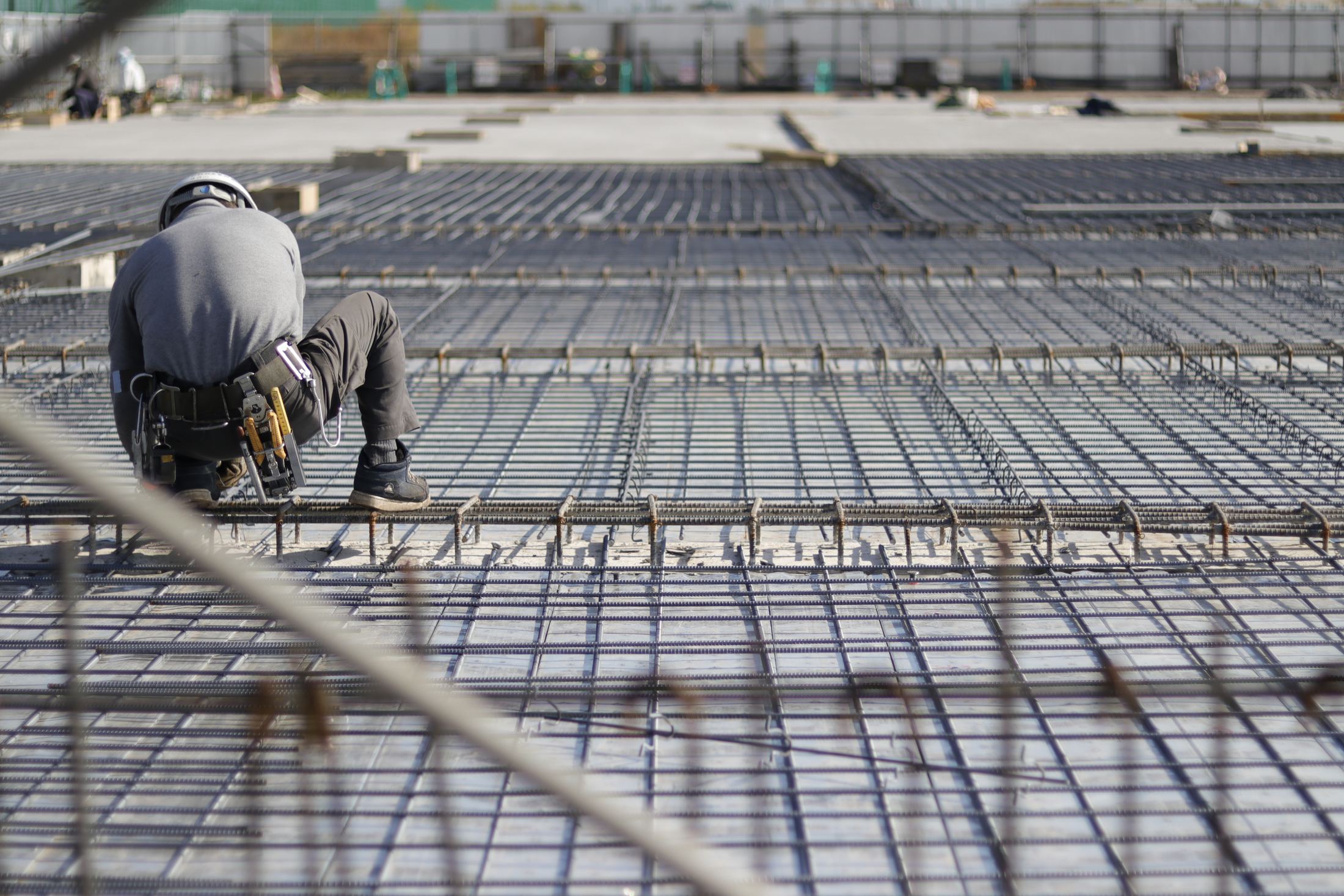
A bar's grade is its minimum yield strength in thousands of pounds per square inch. Grade 60 yields at 60,000 psi. That is the entire definition, and everything else about grade selection follows from it.
Yield is the point at which steel stops springing back and begins to deform permanently. Reinforced concrete design is built around it: the engineer sizes reinforcement so that if anything is ever overloaded, the steel yields first — slowly, visibly, with deflection and cracking as warning — rather than the concrete crushing, which happens suddenly and without notice. Grade is therefore not just a strength number. It is the number the whole failure philosophy is anchored to.
The grades you meet
- Grade 40 — largely historical in commercial work; still appears in light and residential applications.
- Grade 60 — the default across American commercial construction. Nearly every building drawing you open specifies it.
- Grade 75 and Grade 80 — higher strength, used to relieve congestion where the required steel area would otherwise not fit.
- Grade 100 — specialist high-strength applications, with design provisions that are still narrower than for Grade 60.
Grades are also distinguished by weldability and by seismic performance. A bar designated for welding has a controlled carbon equivalent so it can be welded without embrittlement; ordinary bar does not, which is why field welding of reinforcement that was not specified for it is a genuine problem rather than a shortcut. Seismic-qualified bar carries additional requirements on the ratio of tensile to yield strength and on elongation, because a structure designed to survive an earthquake depends on steel that stretches a long way before it breaks.
Why Grade 60 won
It is the balance point. Enough strength that element sizes are efficient, enough ductility that the steel yields visibly before anything fails, and universal enough that supply, fabrication, code provisions and inspector familiarity all assume it. A material everyone in the chain already knows is worth real money on a schedule.
The ductility half of that is underrated. Higher-strength steels generally stretch less before fracture, and a structure reinforced with very high-strength bar gives less warning. Grade 60 sits where the strength is useful and the warning is still generous, which is why codes have developed around it and why departures from it carry extra provisions rather than fewer.
The supply half matters just as much on a live job. Grade 60 in common sizes is stocked, fabricated and delivered as routine across this region. A drawing specifying something unusual introduces a lead time, and a lead time in front of a pour is a schedule risk that has nothing to do with structural performance.
When a job goes higher
Higher grades appear when congestion is the binding constraint — heavy high-rise columns, deep mats, transfer elements where the required area of Grade 60 simply cannot be placed with enough room for concrete to flow. Substituting a higher grade to solve a field problem is not a field decision; it changes development and lap lengths and belongs with the engineer.
The logic is simple arithmetic. A given element needs a certain force carried in tension. Force is area times yield strength, so raising the yield lets you cut the area — fewer bars, or smaller ones, for the same capacity. On a high-rise column or a transfer element where the steel genuinely does not fit, that is the difference between a placeable detail and an unbuildable one.
It has costs. Higher-grade bar needs longer development and lap lengths, because more force has to be transferred into the concrete over the bond surface available — which can claw back some of the congestion relief in exactly the splice regions where congestion is worst. It is also less forgiving on bend radius. And it is, as above, less commonly stocked.
That trade-off is why the decision is a design one. A detailer or a crew swapping grade to make a detail work has changed the lap lengths on that element without recalculating them.
Grade, and the numbers that move with it
Three things change when grade changes, and all three are reasons a substitution cannot be casual.
Development and lap length increase, because they are proportional to the stress being developed. Minimum bend diameter increases, because higher-strength steel is less tolerant of a tight bend. And [minimum spacing and cover](/newsroom/rebar-spacing) interactions shift, because development length depends on cover and bar spacing as well as on grade — the same bar in a congested, low-cover condition needs more length than in a generous one.
This is why "we had Grade 75 on the truck so we used it" is not a neutral substitution even though the steel is stronger. Stronger bar with the old lap length is a weaker splice.
What this means on the deck
Grade shows in the mill markings on every bar. Verifying grade against the bar list before placement takes minutes; discovering a grade mismatch after a pour does not have a minutes-long remedy. It is one of the cheapest checks on the entire job.
The marking is rolled into the steel: the producing mill, the size number, a symbol for the steel type, and the grade — usually as a number, or as one or two continuous longitudinal lines depending on the marking system. It survives handling, weather and mud, which is the point.
The check belongs at delivery and again before placement, because bundles get mixed. Fabrication and tagging is what keeps grade identity attached to the steel from mill to structure, and on agency work that traceability is contractual rather than good practice.
Where a job carries more than one grade — a tower with Grade 75 columns and Grade 60 everywhere else, say — the risk of mixing rises sharply, and the submittal should make the distinction visible on the drawing the crew is holding rather than in a schedule they have to look up.
If you have a set with mixed grades or congested elements and want them looked at before fabrication, that is a conversation worth having.